
Winding is a key process in the manufacture of motor stators and rotors. Among the many winding methods, needle winding (also called in-slot or inner winding) and flyer winding are two common routes, each suited to different coil and core structures. Manufacturers often ask: how should I choose between needle and flyer winding? In fact, there is no absolutely better one between them; the key lies in the product structure and process requirements.
1. Needle (In-Slot) Winding: Principle and Applications
Needle winding, also known as stator inner winding, feeds a nozzle from inside the stator bore and winds the enameled wire into the slots from the inner side. Under CNC multi-axis linkage, the nozzle is lifted and rotated along a programmed trajectory to lay the wire turn by turn. This method is more suitable for inner-wound stators whose slot openings face the bore, with a small inner diameter and relatively slender core, such as certain inner stators of brushless motors and cooling fan motors. Because the nozzle travels inside the slots, the winding follows the slot shape more closely, making it easier to lay wire neatly in a narrow space.
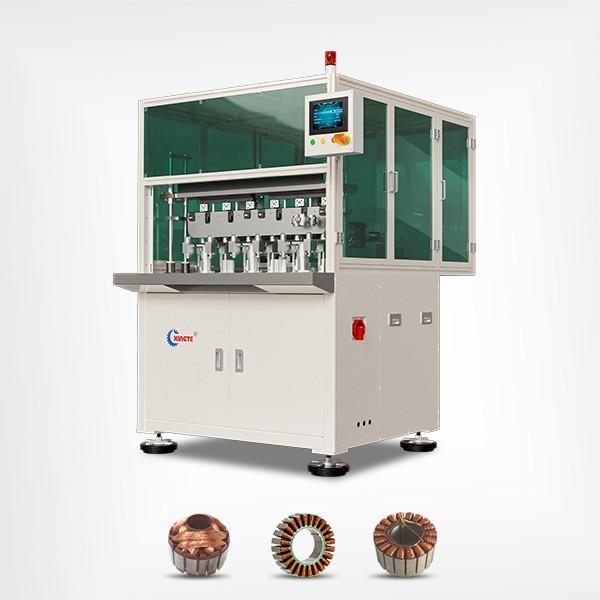
2. Flyer Winding: Principle and Applications
In flyer winding, the wire nozzle is mounted on a rotating flyer arm that circles around a stationary stator or rotor. Together with a guide board and cam mechanism, it lays the enameled wire neatly onto a core whose slots open outward. According to Xingte product information, flyer machines are mainly used for stators and rotors with outward-facing slots, in single-flyer or double-flyer versions, usually with ceramic nozzles. They can continuously complete winding, hook formation, tap-off, slot crossing and wire cutting, generally requiring only manual loading and unloading. Flyer winding is more suitable for outer-wound stators and rotors with larger outer diameter, thicker wire and higher stack height, such as automotive, home-appliance, industrial-fan and drone motors. With a precision wire-laying mechanism, it can also achieve layer-to-layer alignment and adapt to stators with relatively large outer diameters.
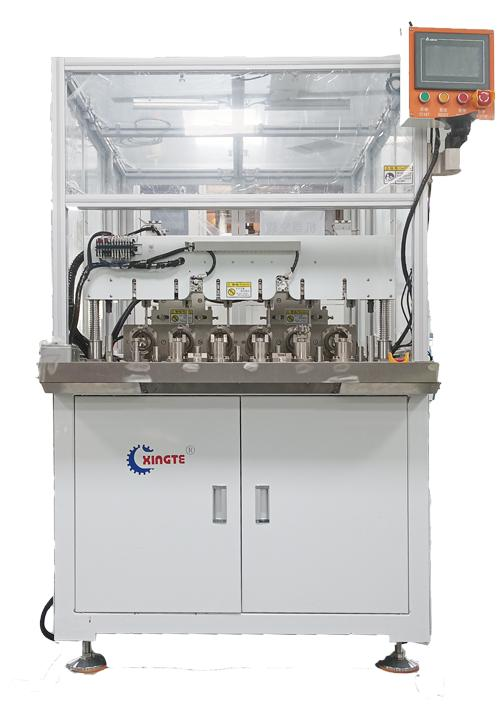
3. How to Choose: Match the Product Structure and Process Needs
The fundamental difference between needle and flyer winding is whether the nozzle winds from the inside or the outside. Generally, inner-wound stators with small bore, slender core and inward-facing slots lean toward needle winding, while outer-wound stators or rotors with larger diameter, thicker wire and outward-facing slots lean toward flyer winding. Manufacturers should also weigh laying quality, multi-strand winding needs, changeover convenience and downstream automation integration, rather than simply concluding which one is “better”.
4. Conclusion
Needle winding and flyer winding each have their own application boundaries; choosing between them is essentially a matter of matching the product structure with the right process route. Shenzhen Xingte Technology Co., Ltd. has long focused on the R&D and manufacturing of high-precision winding equipment. According to the customer product structure, it can provide corresponding solutions such as stator in-slot (needle) winding machines and flyer winding equipment, supporting multi-station synchronization, precision wire laying and quick changeover, to help manufacturers steadily improve winding quality and efficiency across different coil scenarios.