
In consumer electronics, telecom power and automotive electronics, orders for coil products increasingly come in many specifications but small per-order volumes. A factory has to switch the same machine frequently between different wire gauges, strand counts, turn counts and bobbin designs, and the time spent on changeover keeps rising, while batch-to-batch consistency still has to be maintained. For this kind of high-mix, low-volume production, the flexibility of the winding machine often matters more to overall output than the cycle time of any single run.
1. Common Pain Points of High-Mix, Low-Volume Winding
Traditional winding lines are usually built for one product or a few fixed specifications. A changeover often means re-adjusting mechanical fixtures, re-threading the wire, and re-setting tension and trajectory, all heavily dependent on experienced operators. Frequent changeover not only lengthens preparation time but can also cause uneven laying and tension drift in the first few batches after a switch, hurting batch consistency. As specifications become more fragmented and lead times tighter, factories need flexible equipment that switches quickly through programs and parameters while holding winding quality stable.
2. Multi-Strand Winding Machine: Parametric Changeover and Multi-Wire Tension Control
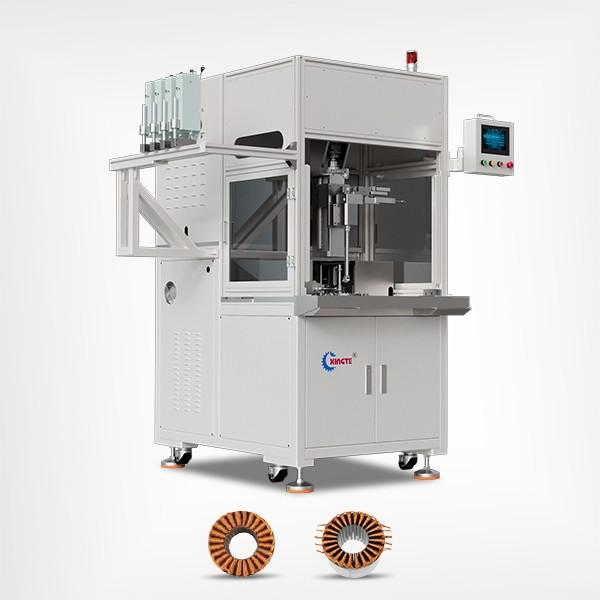
Take the fully automatic multi-strand winding machine. Equipped with high-performance servo motors and a compact structure, it links four axes under numerical control to adapt flexibly to specification changes. Its servo systems control the tension of several wire paths separately, improving slot fill factor and winding accuracy for fine multi-strand winding while simplifying setup. For multi-strand coils used in automotive, IoT, industrial control and drones, handling specification changes through program parameters reduces mechanical adjustment and shortens first-article confirmation after a changeover. The machine lays wire neatly, keeps turns uniform and offers high uptime.
3. Multi-Axis Winding Machine: Fast Changeover and Automatic Scrap-Wire Removal
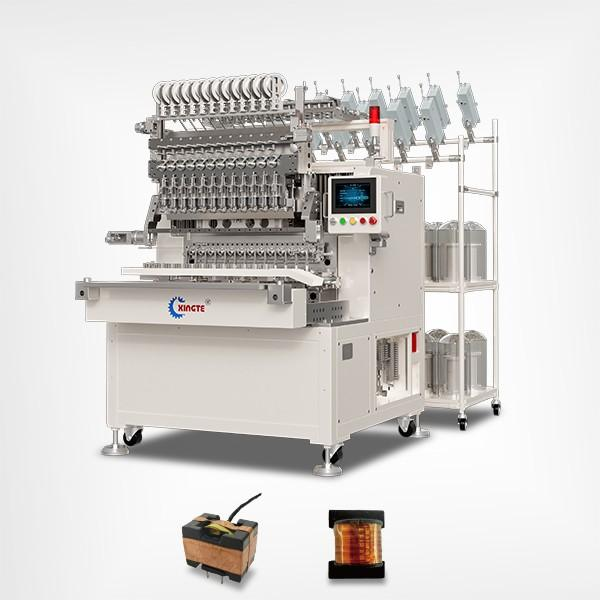
The fully automatic multi-axis winding machine targets bobbin-based coils, completing bobbin loading, spindle winding, tape wrapping and automatic unloading. Programming is done on a PC or touch screen with simple Chinese-English display switching, and program parameters are easy to adjust for quick changeover. It uses precision tensioners with back-tension control together with a unique wire-end clamp design to keep laying neat, and features automatic wire clamping, wire-break detection and scrap-wire removal to reduce winding idle time. It works with a wide range of wires, including single wire, multiple wires, litz wire and triple-insulated wire, suiting mixed orders from white goods, telecom, industrial power, medical and consumer transformers.
High-mix, low-volume production is becoming the norm in coil manufacturing. The value of a flexible winding machine lies in turning frequent specification switches into repeatable, recallable program parameters, cutting setup time and stabilizing batch quality. Shenzhen Xingte Technology Co., Ltd. has long focused on the R&D, production and service of high-precision winding equipment and non-standard automation, and can offer parametric, changeover-ready flexible automation for different coil processes, helping manufacturers maintain efficiency and consistency across mixed-product orders.