
In applications such as new-energy vehicles, industrial servo systems and drones, the power density, efficiency and thermal performance of a motor depend largely on how neatly the copper wire is arranged inside the stator slots. A higher copper fill factor (also known as slot fill factor) allows more copper to be packed into a given slot volume, which in turn supports better electromagnetic conversion efficiency and heat dissipation. As downstream products demand higher motor performance, stator winding processes are shifting from manual and semi-automatic methods toward high-precision automated winding.
1. What Is Copper Fill Factor and Why It Matters
The copper fill factor is the ratio of the cross-sectional area of copper wire to the effective volume of a stator slot. For a fixed lamination size, a higher fill factor means more copper can be accommodated, enabling greater torque output and lower resistive loss within the same motor volume. Conversely, excessive empty space in the slots reduces material utilization and can affect temperature rise and long-term reliability. Improving the fill factor has therefore become one of the key process goals in new-energy stator manufacturing.
2. Common Process Factors That Limit Fill Factor
In production, the fill factor is constrained by several linked factors: whether the wire is laid neatly in layers without crossing, overlapping or loosening; whether multiple thin strands maintain equal tension and enter the slot together; whether the nozzle trajectory and core positioning are precise enough to avoid wire snagging or bending at the slot opening; and whether tension remains stable so the enameled wire is neither over-stretched nor slack. Manual winding relies heavily on operator experience and is difficult to keep consistent batch to batch, which limits further improvement of the fill factor.
3. How Automated Winding Improves the Fill Factor
Automated stator winding machines bring wire-laying trajectory, tension and feed rhythm under closed-loop control through numerical control, servo drives and precision nozzle mechanisms, delivering more consistent and denser winding than manual operation. For example, an in-slot stator winding machine uses CNC technology and multi-axis servo linkage to control the nozzle and core position precisely and follow a programmed trajectory. Its segmented wire-feeding function independently adjusts the nozzle lift at each layer to prevent enameled wire slack, keeping the winding neat and turns uniform, which supports denser copper arrangement inside the slots.
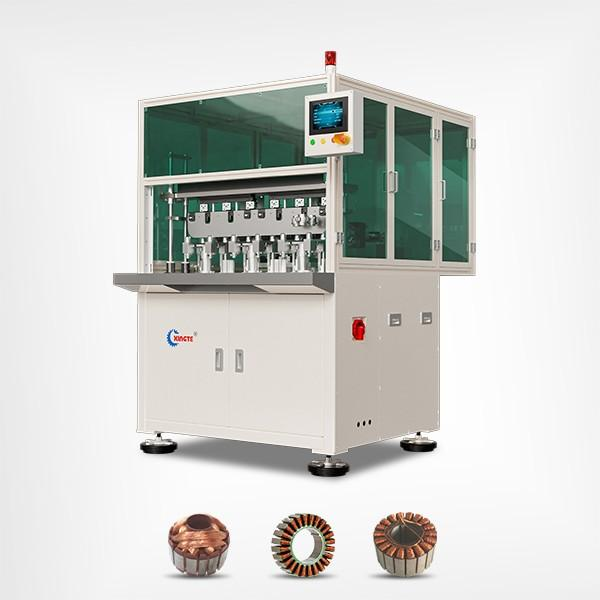
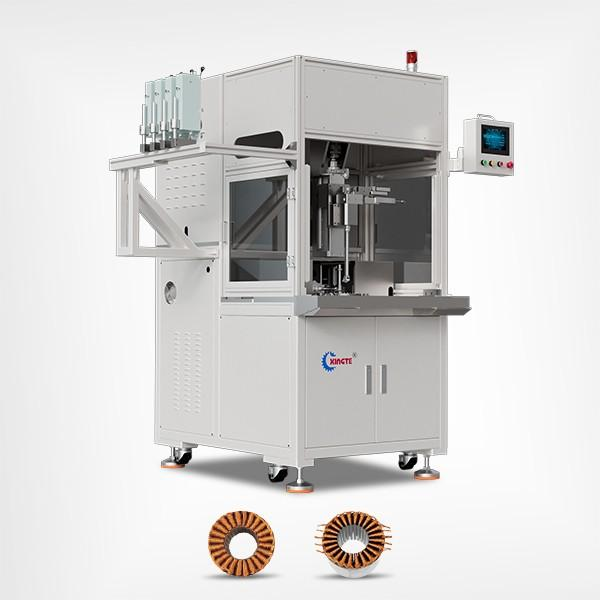
For stators wound with multiple thin strands, a multi-strand winding machine uses servo systems to control the tension of several wire paths separately and completes synchronized multi-strand winding under four-axis CNC linkage. This improves slot fill factor and winding accuracy while simplifying setup. The machine delivers neat laying, uniform turns and high uptime, and can support batch production of multi-strand stators used in automotive, industrial control, IoT and drone applications.
4. Selection Considerations and Conclusion
When evaluating winding equipment, manufacturers should consider their stator slot geometry, wire gauge and strand count, production cycle time and future changeover requirements, focusing on trajectory accuracy, multi-strand tension consistency, winding neatness and flexible changeover capability. Shenzhen Xingte Technology Co., Ltd. has long specialized in the research, production and service of high-precision winding equipment and non-standard automation solutions, offering one-stop automation from winding to final assembly to help motor manufacturers improve stator winding quality and production consistency.