
Because coreless motors use a slotless, iron-free winding with low inertia, fast response and high efficiency, they are widely used in portable medical devices, smart hardware, service robots and drones. However, a coreless coil winding is thin and light and wound from fine wire; after winding it must still go through lead tap-off, flattening and hot pressing before it becomes a stable finished part. When production relies on manual operation, operator stability and batch-to-batch consistency often become the bottleneck for scaling up output.
1. Why Coreless Windings Are Difficult to Mass Produce
Unlike a conventional slotted stator winding, a coreless motor winding forms a thin-walled cup shape made of fine enameled wire, with many turns and an irregular contour. Three challenges stand out in mass production: first, the wire is very fine, so even small tension variation can over-stretch or loosen it; second, the wound coil is not yet its final shape, and needs lead tap-off, flattening and hot pressing before it becomes a dimensionally stable part; third, the process steps are tightly linked, and manual gestures, force and rhythm vary from person to person, making batch consistency hard to control and human error a direct source of defects.
2. Tap-off, Flattening and Hot Pressing: Forming Consistency Decides Quality
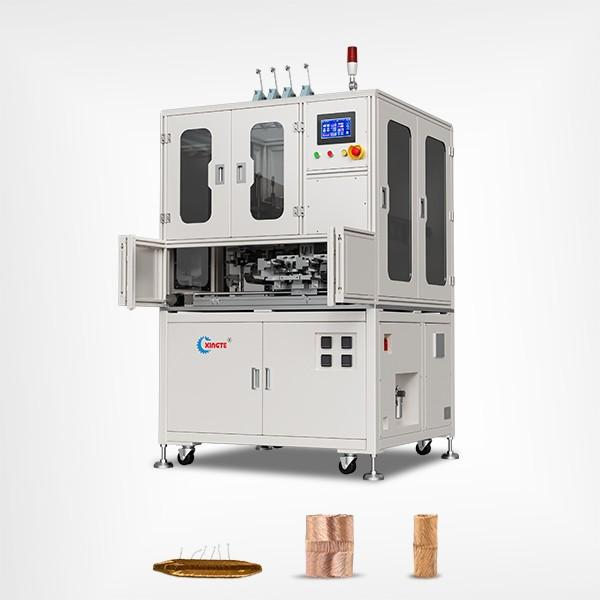
From winding to finished part, a coreless coil goes through clamping, winding, tap-off, flattening, hot pressing and unloading in sequence. The tap-off step determines the lead position and the reliability of later soldering; flattening decides whether the winding contour stays even; and hot pressing cures the loose coil into a flat-pressed heated coil sheet with stable dimensions. When these steps are split across manual stations, cycle time is slower and the geometry and lead position of each coil are hard to keep consistent. Whether all these steps can be integrated into one machine and handed over automatically is therefore a key criterion for judging whether a coreless winding machine suits mass production.
3. Key Selection Considerations for Automated Winding Machines
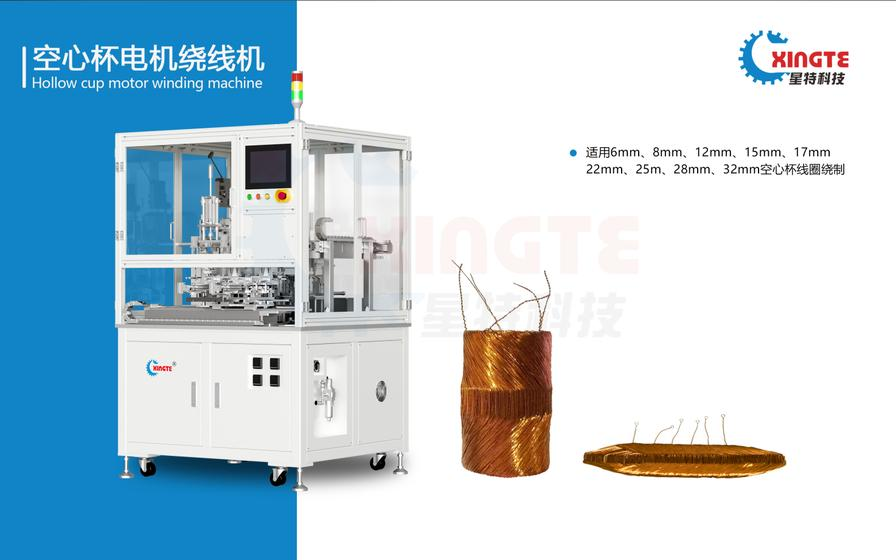
When choosing equipment for coreless motor production, manufacturers can focus on the following points. First is process integration: an ideal machine should link clamping, winding, tap-off, flattening, hot pressing and unloading in one line, with no manual intervention throughout, and directly output a flat-pressed heated coil sheet, reducing defects caused by human error and improving labor efficiency. Second is multi-specification adaptability: as coreless motors come in many sizes, a machine that covers a wide range of coil diameters (the Xingte machine, for example, supports common specifications from 12mm to 32mm) and offers quick changeover is better suited to mixed orders. Third is tension and trajectory stability: since the winding is thin, stable wire tension and nozzle motion directly affect turn arrangement and contour consistency. Fourth is uptime and after-sales response: continuous production calls for stable running, easy setup and timely technical support.
4. Conclusion
In short, the core challenge of coreless motor mass production lies in the consistency of a multi-step forming process built around a thin winding. Leaving winding, tap-off, flattening and hot pressing in a closed automated loop is an effective way to stabilize winding quality and improve batch consistency. Shenzhen Xingte Technology Co., Ltd. has long focused on the R&D and manufacturing of high-precision winding equipment and non-standard automation. Its coreless motor winding machine supports brushed and brushless coreless motors and joint-motor coils, offering a one-stop automation solution from winding to formed unloading, helping manufacturers steadily improve winding quality and efficiency under mixed-product, quick-changeover requirements.