
Recently, the C-FOL (Fiber Online) team visited its member enterprise — Shenzhen Suntop Technology Co., Ltd. (referred to as “Suntop Technology”). As a national-level Key Little Giant enterprise founded on motors, magnetic components, intelligent precision optical equipment and non-standard flexible automated production lines, Suntop is rapidly rolling out full-chain automation solutions for optical devices and optical modules in the optical communication sector, covering processes including high-speed optical module coupling, FA dispensing, AWG/fiber core end-face inspection and FAU six-side inspection.
Building on its experience in automated assembly of ultra-precision optical components for mobile phone and camera lenses, Suntop has successively launched equipment such as dual-Lens coupling machines for 400G/800G/1.6T high-speed optical modules, full-automatic FA dispensing lines, AWG end-face testers and FAU six-side inspection systems, quickly covering many popular process directions in optical communications. Amid such rapid expansion, questions have emerged within the industry: Is Suntop simply jumping on the bandwagon?
Deng Lizhong, Marketing Director of Suntop Technology, stated that the layout of its optical communication product line traces upstream to the root causes of yield pain points faced by optical module customers, which has shaped its current equipment portfolio.
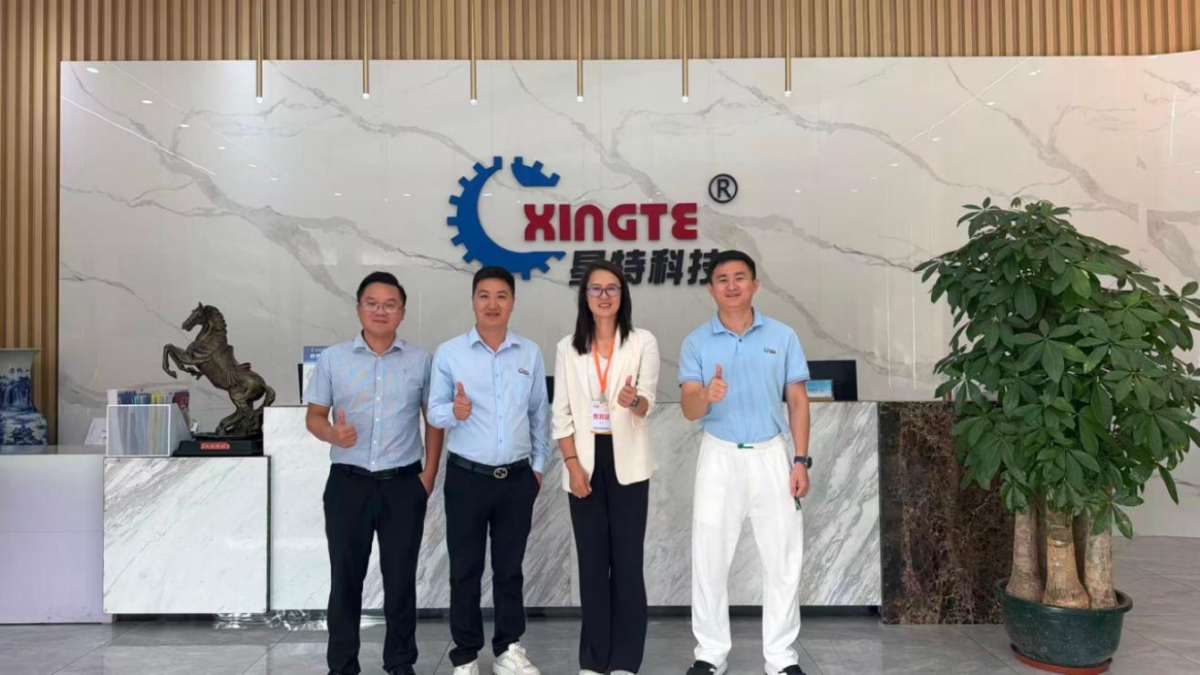
From left: Wang Qun, Marketing Manager of Suntop Technology; Deng Lizhong, Marketing Director; Tang Rui from C-FOL; Hu Bing, Sales Engineer
Fifteen Years of Precision Automation Expertise: Reusing Automation Technology from Headphones & Lenses to Optical Modules
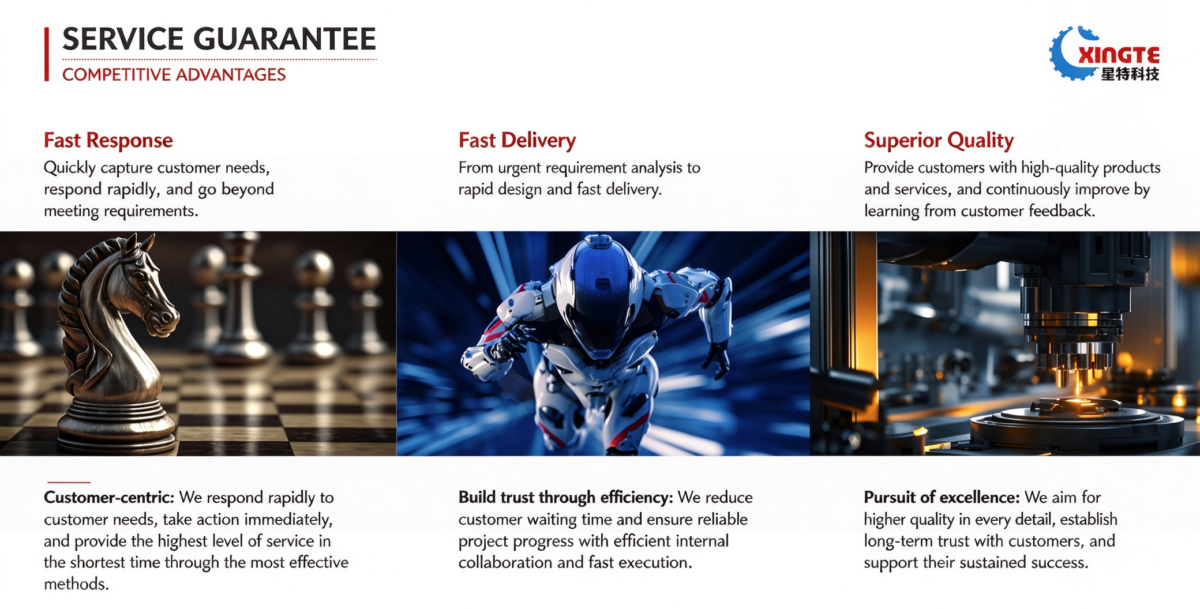
Founded in 2011, Suntop Technology established its precision machining center in 2013 and became a supplier to global leading 3C manufacturers in 2019. It took six years from the launch of the machining center to entry into top-tier supply chains, growing into a premium supplier of automation solutions for high-precision consumer components. The Suntop team told our editor that its corporate culture is customer-centric, guided by three core principles: Think Ahead (advanced pre-analysis), Swift Delivery (fast design, production and delivery), and Superior Quality (reliable products and services).
From C-FOL’s perspective, Suntop’s most outstanding credential lies in its accumulated precision manufacturing capabilities. Titles including National Key Little Giant Enterprise, National Green Factory and Guangdong Provincial Manufacturing Single Champion are backed by 15 years of deep cultivation in motors, magnetic components and intelligent precision optical equipment. In particular, it has amassed rich experience in mass full-line automated assembly for ultra-high-precision optical parts such as mobile phone and camera lenses.
“The capability for full-line assembly of precision components forms the technical foundation we reuse in the optical communication industry,” said Deng Lizhong in the interview. While the leap from consumer electronics to optical communications seems substantial, the underlying core capabilities overlap: micron-level alignment accuracy, flexible multi-station scheduling, and stable mass-production yield — all essentials for precision automated production lines.
Its pivot into optical communications was driven by a major domestic optical module manufacturer. Suntop’s first optical communication equipment was the dual-Lens automatic coupling machine for high-speed optical modules. Compatible with single/dual-Lens, multi-channel Lens, FA, AWG and other component formats, this machine completes coupling on a single platform to deliver true flexible production. It supports the assembly of 400G, 800G and even 1.6T optical modules, and caters to emerging packaging forms such as CPO, silicon photonics and high-speed optical engines.
Starting from Dual-Lens Coupling: Tracing Root Causes of Yield Issues
After the delivery of dual-Lens coupling machines, Suntop observed an interesting trend: the coupling process itself delivered excellent yield and won customer recognition, yet the final yield of finished optical modules fell short of expectations.
“We dug deeper to figure out why coupling performed well but finished product yield remained low,” Deng explained. The root cause lay in upstream components: consistency of FA assembly, end-face defects and quality of AWG devices. These issues originated in front-end processes but only surfaced at the finished-product stage.
Based on this insight, Suntop’s optical communication portfolio expanded from just coupling to automatic FA dispensers, AWG end-face testers, fiber core end-face inspection systems and FAU six-side inspection machines, forming a complete matrix of solutions covering core optical module manufacturing steps.
This perfectly embodies Suntop’s customer-centric culture: Think Ahead, Swift Delivery, Superior Quality.
Upstream Expansion: Full-Chain Layout for FA Dispensing and End-Face Inspection
Driven by the accelerated boom in AI applications in 2026, demand for high-speed optical modules remains tight. FA fiber arrays, as core components, still rely heavily on manual production. Hu Bing, Sales Engineer at Suntop Technology, introduced that with rapid FA capacity expansion, competition in automatic dispensing machines has shifted from standalone dispensing precision toward full-line efficiency, yield stability and multi-rate compatibility.
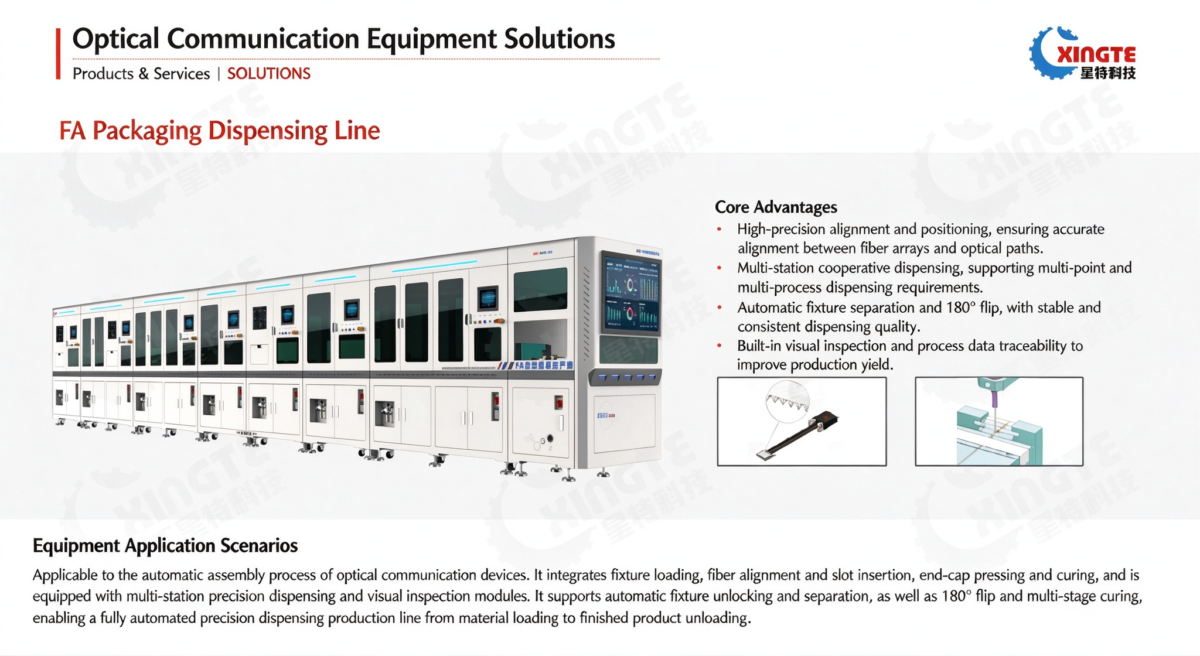
(1) Automatic FA Dispensing: Full-process Automation from Feeding to Finished Part Unloading
Suntop’s automatic FA dispensing system integrates fixture loading, precision fiber alignment and slot insertion, end-cap clamping, thermal curing and other procedures. High-precision alignment guarantees good yield for fiber arrangement and optical path alignment. Equipped with a multi-station precision dispensing module, it supports dispensing inside slots, at tails and on heads. It also features automatic fixture unlocking & separation, 180° flipping and multi-stage curing, enabling fully automated assembly from material feeding to finished product pickup.
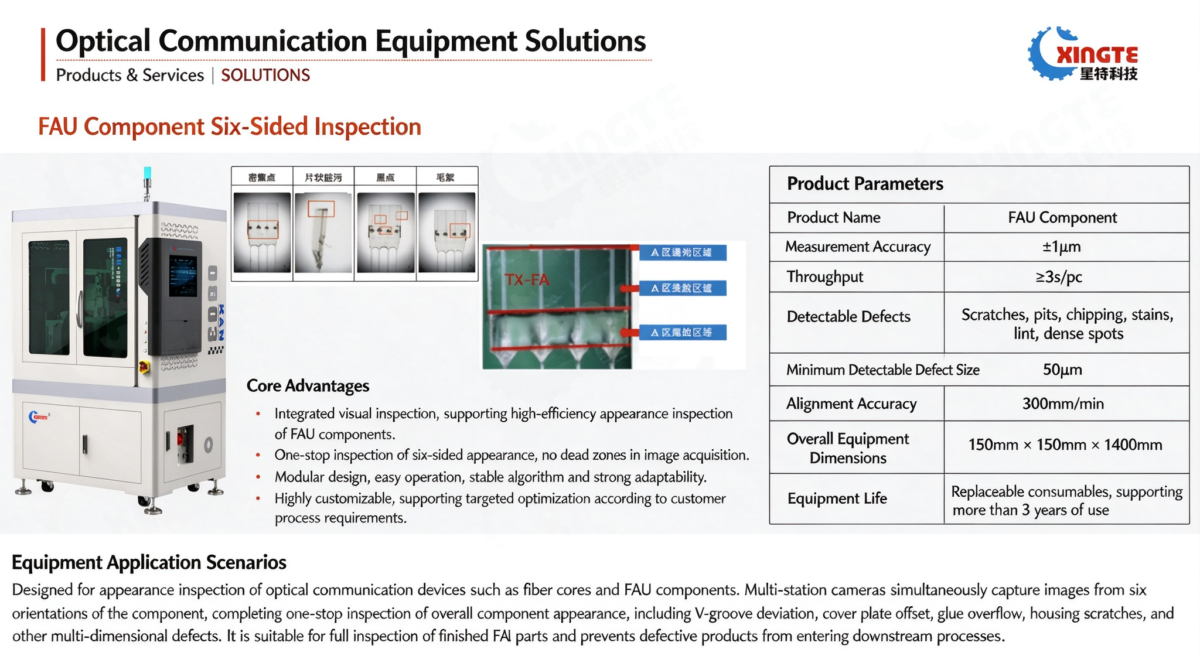
(2) FAU Six-Side Inspection: One-Shot Imaging for Full-Range Visual Screening
To further improve FAU component yield, Suntop developed the FAU six-side inspection machine. Multiple cameras simultaneously capture images from six orientations of the component to complete multi-dimensional screening for dimensions, V-groove offset, glue overflow, housing scratches and more in a single pass. It automatically detects contaminants, fingerprints, residual glue, lint, dense spots and other defects, conducting full visual inspection of finished FA parts to block defective units from entering downstream processes. One shift of this machine can replace three human inspectors.
(3) AWG End-Face Inspection: Inline Quality Control with High-Magnification Microscopy + AI Algorithms
Moving further upstream, Suntop also launched the AWG end-face tester for arrayed waveguide grating devices. Using non-contact high-magnification microscopic imaging and AI image algorithms, it detects end-face scratches, chipping, stains, waveguide damage and other defects on chips, while measuring geometric parameters such as channel position and pitch. Designed for inline mass production QC, it stores traceable inspection data and supports connection with factory MES systems.
(4) Single Fiber Core End-Face Inspection: Dual Scenarios of Incoming Screening and Finished Recheck
Fiber end-face quality control has long been a pain point in optical communication manufacturing. Suntop’s single fiber core end-face inspection machine works with TOSA/ROSA and single-fiber FA assemblies. It automatically completes focusing, image capture and intelligent analysis to identify scratches, pits, chipping and contamination on fiber cores and assess lapping quality. It can be deployed either for incoming material screening before component assembly or finished-product recheck after coupling, safeguarding optical link transmission performance.
Engineer Culture: The Underpinning of Precision Manufacturing
Inside Suntop’s workshop, we saw batches of full-line equipment for high-precision optical components such as phone lenses ready for shipment. Equally impressive was a dedicated engineer culture wall.
Suntop currently employs around 1,400 staff, nearly 30% of whom are engineers. It holds 140 patents and operates 8 global service sites.
Hu Bing shared that Suntop has a robust career growth and promotion framework for engineers, alongside complete equipment assembly lines. “This is the fundamental guarantee for precision manufacturing.” For an enterprise built on precision assembly, its engineer culture represents organizational capability forged over 15 years: every stage, from requirement breakdown and solution design to assembly and commissioning, is refined by the engineering team with craftsmanship.
As Director Deng put it, every new product development at Suntop stems from analysis of customer pain points. The goal is clear: upon entering a sector, fully validate the corresponding products, all toward one shared objective — helping customers continuously boost the mass-production yield of optical modules.