
Winding tension is the core process parameter that determines coil forming quality. In actual production on fully automatic winding machines, whether tension control is stable directly determines the winding layout quality, electrical performance and final yield. Many coil manufacturers tend to ignore this “hidden killer” when troubleshooting defects, resulting in recurring quality problems that are hard to explain. This article systematically sorts out the various coil defects that unstable tension can cause, helping production and process personnel quickly locate the root cause.
1. Defects caused by excessive tension. When winding tension is consistently too high, the enameled wire is over-stretched during winding, causing the conductor to become thinner and its cross-section to shrink, so the coil resistance rises and temperature rise increases. More seriously, under high tension the enamel film is prone to damage and pinholes, reducing the coil’s withstand voltage and dielectric strength, which easily leads to inter-turn short circuits or breakdown during later use, directly affecting product reliability and safety.
2. Defects caused by insufficient tension. When tension is inadequate, the winding becomes loose, and turns do not fit tightly together, easily causing layer overlap, tangled or collapsed winding, resulting in out-of-tolerance outer dimensions and unqualified fill factor. This not only affects appearance but also causes uneven magnetic flux distribution, making the performance parameters of motors or transformers fluctuate. For fine-wire coils, insufficient tension also tends to cause “wire springing”, increasing breakage probability and affecting production continuity.
3. Unstable quality caused by tension fluctuation. Even if the average tension seems reasonable, if tension fluctuates greatly during winding, it still causes uneven turn spacing and layer misalignment, leading to large dispersion in parameters such as inductance and impedance across the same batch, obvious yield fluctuation, and increased inspection and rework costs.
4. How to effectively control winding tension. To solve the above problems, the key is to adopt a high-precision fully automatic winding machine with closed-loop tension control capability. By monitoring and feedback-adjusting tension in real time, the equipment can precisely and stably control tension under different wire diameters and winding speeds, fundamentally avoiding coil defects caused by unstable tension.
5. XINGTE’s tension control advantage. XINGTE has been deeply engaged in precision winding equipment for many years. Its high-precision fully automatic winding machines are equipped with a self-developed closed-loop tension control system, achieving constant-tension precision control of fine-wire coils and stably adapting to winding requirements for wire diameters of 0.01-0.8mm, with neat winding, uniform turns and stable mass-production yield.
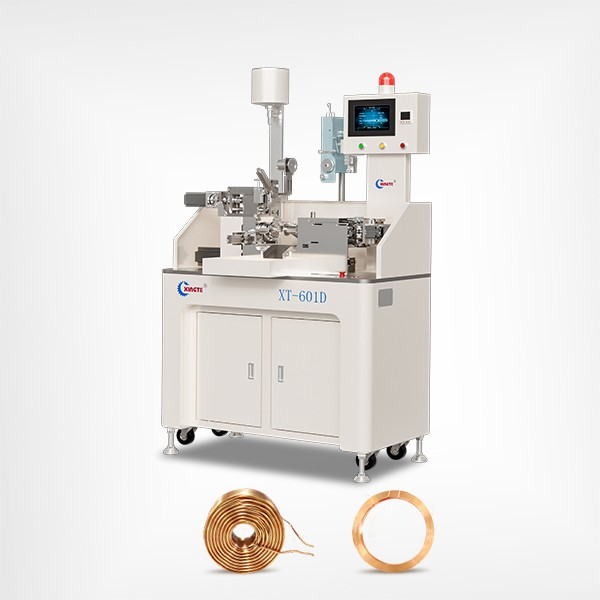
In actual production, many defects are actually chain reactions of unstable tension. For example, when the tension control system responds slowly or mechanical part wear causes tension drift, the equipment may sometimes over-pull and sometimes relax, ultimately showing as mixed parameter fluctuation and appearance defects across the same batch, greatly increasing inspection and rework workload. Therefore, when selecting winding equipment, companies should not only focus on winding speed and spindle count, but should focus on the accuracy and stability of the tension control system, as well as whether complete tension calibration and maintenance support are available.
In short, for coil manufacturers pursuing high consistency and high yield, choosing winding equipment with precise and stable tension control is an important foundation for reducing defect rates, stabilizing quality and enhancing product competitiveness.